

The Public Development Banks (PDBs) and Development Financing Institutions (DFIs) database team is pleased to announce the release of 2024 fiscal year data. The update concerns seven core indicators, including total assets for all included institutions with available data. This update strengthens the database’s role as a comprehensive resource for public development finance research and practice, while continuing efforts to enhance transparency and data accessibility.
New 2024 Fiscal Year Financial Indicators
Building on the panel data structure launched in Q3 2025, the database now includes complete time-series data (2018–2024) for seven critical financial indicators across all institutions in the database. The newly added 2024 fiscal year data covers:
● Total assets
● Total equity
● Total liabilities
● Net income
● Profit before tax
● Net interest income
● Number of employees
This development allows in-depth analysis of financial profiles, efficiency, and sustainability over time, and enhances the database’s value as a unique global reference for tracking the scale and evolution of PDBs and DFIs in the global financial architecture.
Notably, the data collection process maintained the rigorous quality control standards established in previous updates: a three-round verification mechanism conducted by researchers from Peking University (PKU), Agence Française de Développement (AFD), and Fondation pour les Études et Recherches sur le Développement International (FERDI).
The data are available for free download on the Data Downloading webpage.
Aggregated Total Assets for 2024 Fiscal Year
The database team has completed the collection and verification of total asset data for 544 PDBs and DFIs globally. Among these institutions, 312 report available financial information for the 2024 fiscal year, forming the basis for the latest aggregate asset estimates and trend analysis. It is estimated that aggregate total assets of all 540+ PDBs and DFIs add up to USD 23 trillion.
Of the 312 institutions with available data, the total adds up to USD 22,001 billion with a modest decrease of 0.4% compared with the year of 2023. Specifically, roughly half of the institutions recorded a decline in total assets in USD terms, whereas 53% witnessed an increase in total assets in USD terms. Notably, Kreditanstalt für Wiederaufbau (Mega) reported an asset reduction of approximately 9 percent, falling from USD 619 billion in 2023 to USD 564 billion in 2024. The U.S. Small Business Administration (Large) experienced a decrease of about 13 percent, with total assets declining from USD 316 billion to USD 276 billion over the same period. This trend does not necessarily imply a weakening of development mandates or activities. Rather, it may reflect a combination of factors, including post-crisis balance-sheet normalization following earlier counter-cyclical expansions, increased reliance on catalytic and risk-sharing instruments that are less fully reflected on balance sheets, currency valuation effects with respect to US dollar, and more cautious balance-sheet management amid tighter global financial conditions.
Table 1. 10 largest institutions by total assets in 2024
No. |
ISO-2 |
Code |
PDB&DFI Name |
Name in Original Language |
Acronym |
Total Assets Mls USD |
1 |
US |
US19381 |
Fannie Mae |
Fannie Mae |
Fanniemae |
4,349,731 |
2 |
US |
US19701 |
Freddie Mac |
Freddie Mac |
Freddiemac |
3,386,692 |
3 |
CN |
CN19941 |
China Development Bank |
国家开发银行 |
CDB |
2,550,656 |
4 |
CN |
CN19943 |
Agricultural Development Bank of China |
中国农业发展银行 |
ADBC |
1,459,080 |
5 |
FR |
FR18161 |
French Deposits and Consignment Fund Group |
Groupe Caisse des Dépôts France |
CDCFrance |
1,070,672 |
6 |
CN |
CN19942 |
The Export-Import Bank of China |
中国进出口银行 |
China Eximbank |
886,008 |
7 |
MB |
MB19581 |
European Investment Bank |
European Investment Bank |
EIB |
602,551 |
8 |
DE |
DE19481 |
Credit Company for Reconstruction |
Kreditanstalt für Wiederaufbau |
KfW |
564,481 |
9 |
IT |
IT18501 |
Deposits and Loans Fund |
Cassa depositi e prestiti |
CDP |
494,779 |
10 |
CA |
CA19651 |
Deposits and Investment Fund of Quebec |
Caisse de dépôts et Placement du Québec |
CDPQ |
398,150 |
| 15,762,801 |
Note: In 2024, the combined total assets of the ten largest institutions account for 72% of the aggregate assets reported in the PDBs and DFIs database.
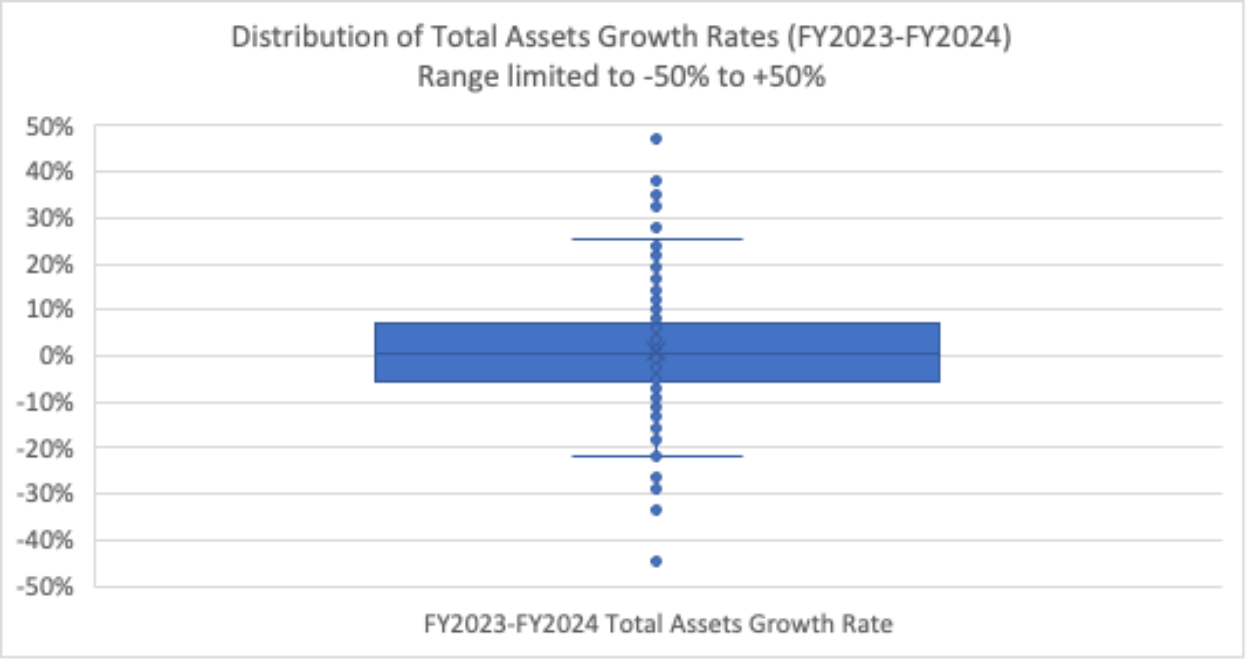
Figure 1. Distribution of FY2023-FY2024 Total Assets Growth Rates
Note: For clarity of presentation, the range is limited to the -50% to +50%. Nine institutions with FY2023-FY2024 total assets growth rates exceeding this range are excluded from the figure: GT19291 (51%), UZ20191 (54%), TR19931 (59%), GB20211 (84%), LT20011 (160%), PK19811 (206%), OM19971 (290%), UZ20171 (629%), and US20173 (4,996%).
Forthcoming Steps
The team remains committed to advancing original research in public development finance and unlocking the potential of PDBs and DFIs to drive progress toward the Sustainable Development Goals. The database continues to expand its institutional coverage while improving data consistency and comparability across countries and over time. Ongoing efforts focus on incorporating additional fiscal-year observations and strengthening longitudinal financial series.
Moving forward, the database team will continue to proactively and rigorously update the global list of PDBs and DFIs, including their basic information, key financial indicators, and thematically-focused data modules.
To learn more, please visit our data visualization website (http://www.dfidatabase.pku.edu.cn/) to register and download the database for free. For using the information from the database, please cite:
Xu, Jiajun, Régis Marodon, Xinshun Ru, Xiaomeng Ren, and Xinyue Wu. 2021. “What are Public Development Banks and Development Financing Institutions? ——Qualification Criteria, Stylized Facts and Development Trends.” China Economic Quarterly International, volume 1, issue 4: 271-294. DOI: https://doi.org/10.1016/j.ceqi.2021.10.001.
Database DOI: https://doi.org/10.18170/DVN/VLG6SN.
We welcome feedback from academia, policymakers, practitioners from PDBs and DFIs, and other stakeholders to provide constructive suggestions and fill gaps in the database. Please contact us at nsedfi@nsd.pku.edu.cn.