

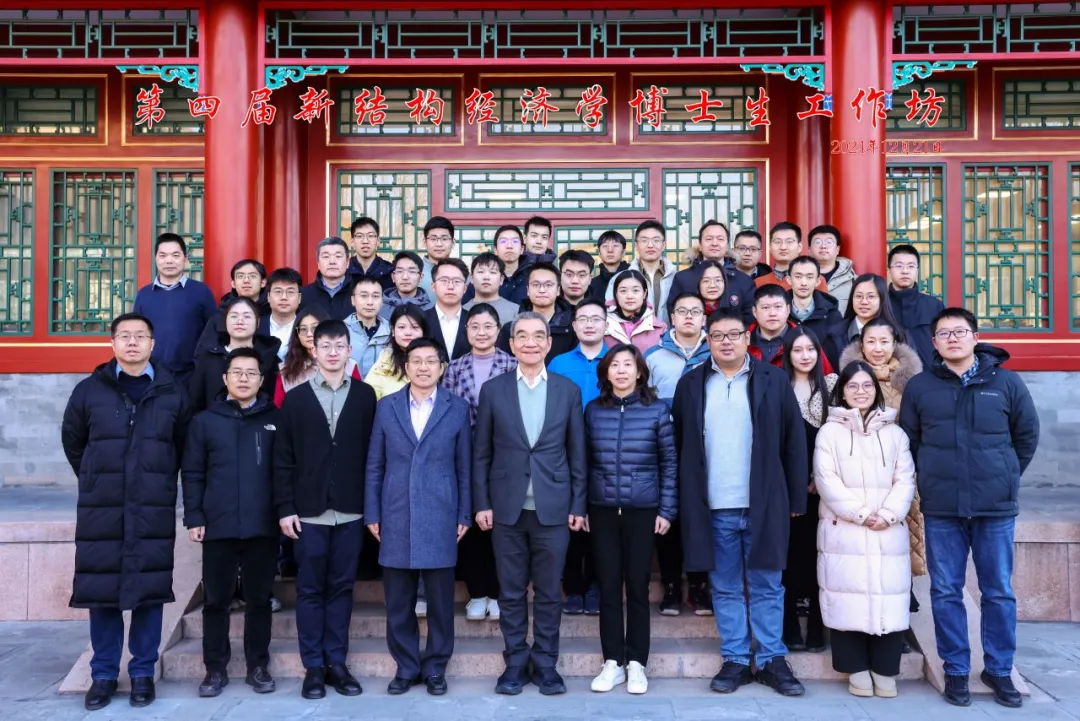
From December 21 to 22, 2024, the Fourth New Structural Economics Doctoral Workshop was successfully held at Langrun Garden, Peking University. Nine doctoral students and postdoctoral researchers from universities including Peking University, Jilin University, Shanghai University, Yunnan University, and the University of Nottingham Ningbo China presented their academic papers at the workshop. Over twenty distinguished scholars and editors of important academic journals were invited as guests to provide professional commentary on the papers. This workshop provided a platform for doctoral students from our institute to enhance academic exchange and showcase their research findings, helping them broaden their horizons, improve academic and research capabilities, better master and deepen their study of the New Structural Economics theoretical framework, and thereby advance theoretical innovation in New Structural Economics.
The opening ceremony was chaired by Wang Yong, Associate Dean and Tenured Associate Professor of the Peking University Institute of New Structural Economics, and Secretary-General of the New Structural Economics Research Alliance.
Professor Justin Yifu Lin, Dean of the Peking University Institute of New Structural Economics, delivered an opening speech. He began by expressing gratitude to the attending guests and conveyed his ardent expectations for the students. He pointed out that the 21st century is the century for Chinese economists, a century when masters leading new waves of thought in world economic theory will emerge in succession in China. He expressed his hope that students would develop broad perspectives and understand the changes occurring in the world to seize the opportunities of the era. Theories are summaries of past experiences and phenomena. As times change, the theories that explain the principles behind phenomena must also change accordingly. He emphasized the need for students to personally observe phenomena, understand their essence, identifying factors, and mechanisms, in order to better help people understand and transform the world, make genuinely beneficial contributions to economic scholarship, and live up to the opportunities bestowed by the times.
Professor Bai Yan, Chair of the Department of Economics at the University of Rochester, delivered a keynote lecture and engaged in academic exchange with faculty and students present. Professor Bai delivered a speech titled "The Neoclassical Model of World Financial Cycles," outlining the four distinct phases global financial cycles have undergone from 1994 to 2023, which exhibited different co-movement patterns among US corporate bond spreads, US equities, and emerging market sovereign debt spreads. Based on this, she constructed a corresponding model for interpretation, offering a new perspective for understanding global financial cycles. Following the lecture, Professor Bai interacted with the audience, providing detailed answers to questions raised by faculty and students.
The academic presentation session on the morning of December 21 was chaired by Wang Yong, Associate Dean and Tenured Associate Professor of the Peking University Institute of New Structural Economics, and Secretary-General of the New Structural Economics Research Alliance. Doctoral students Zhong Ruixuan and Xu Wan from the Peking University Institute of New Structural Economics delivered their presentations.
The academic presentation session on the afternoon of December 21 was chaired by Wang Ling, Lecturer from the School of Public Finance and Taxation at Zhongnan University of Economics and Law. Presentations were given by Dilixiati·Wubuli, Special-term Associate Researcher at the Peking University Institute of New Structural Economics; Zhang Xiaoou, doctoral student from the School of Economics at Jilin University; Guo Hongxing, doctoral student from the School of Economics at Shanghai University; Cai Hualong, doctoral student from the School of Economics at Yunnan University; and Li Haolin from the Faculty of Science and Engineering (China) at the University of Nottingham.
The academic presentation session on the morning of December 22 was chaired by Jiang Shenzhe, Associate Dean and Tenured Associate Professor of the Peking University Institute of New Structural Economics.
Professor Hong Yongmiao, Guan Zhao Zhi Chair Professor at the Academy of Mathematics and Systems Science, Chinese Academy of Sciences, and Dean of the School of Economics and Management at the University of Chinese Academy of Sciences, delivered a keynote speech titled "The Evolution of Empirical Research Methods in Economics in the Big Data Era." Through presenting research findings, Professor Hong offered numerous academic insights. For instance, he suggested that first using large models to model high-dimensional complex data, and then performing dimensionality reduction on these large models, can comparatively make full use of big data information, reduce the possibility of information loss or distortion, and significantly enhance out-of-sample prediction capability and causal inference capacity. Finally, Professor Hong emphasized that statistical inferences based on observational data, if intended to be interpreted as causal relationships, require reliance on domain-specific knowledge and cannot depend solely on statistics, data science, and artificial intelligence themselves. He stressed the importance of focusing on the interpretability of statistical and AI methods, particularly their economic interpretability. After the speech, faculty and students actively participated in a Q&A session, and Professor Hong meticulously addressed the related questions.
Doctoral students Ding Xingjian and Tian Ruize from the Peking University Institute of New Structural Economics presented their papers.
The closing ceremony was chaired by Jiang Shenzhe, Associate Dean and Tenured Associate Professor of the Peking University Institute of New Structural Economics. Professor Justin Yifu Lin, Dean of the Institute, delivered the closing remarks. He expressed heartfelt thanks to the experts for their insightful comments and also encouraged the students to continue striving hard to contribute to promoting innovation in economic theory and live up to the significant responsibilities of the era.