

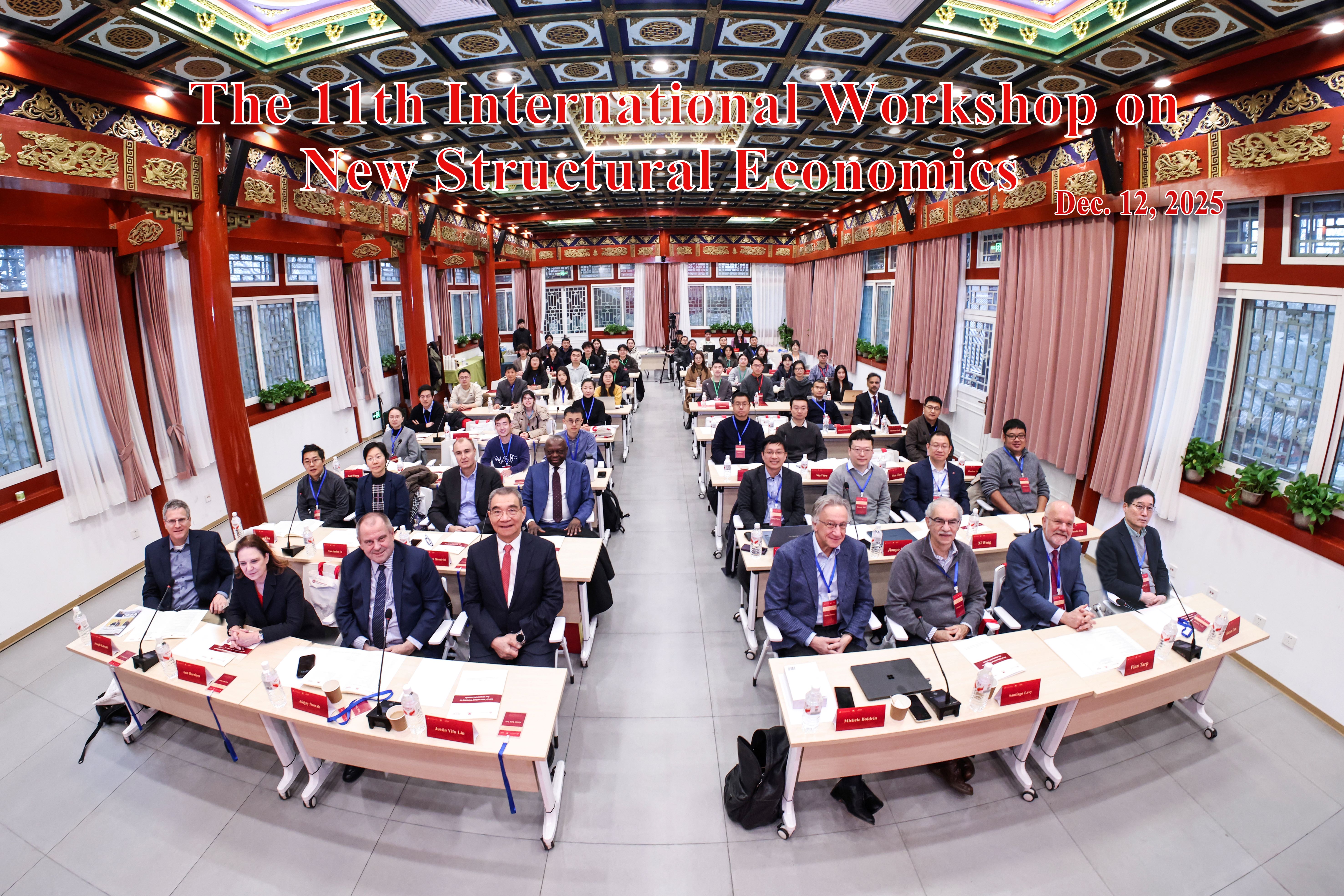
The 11th International Workshop on New Structural Economics (NSE) was successfully held in a hybrid format at the Wanzhong Building, Langrun Yuan, Peking University on December 12, 2025. Hosted by the Institute of New Structural Economics (INSE) at Peking University, the workshop brought together scholars from China and abroad for extensive and in-depth exchanges and discussions on New Structural Economics (NSE).
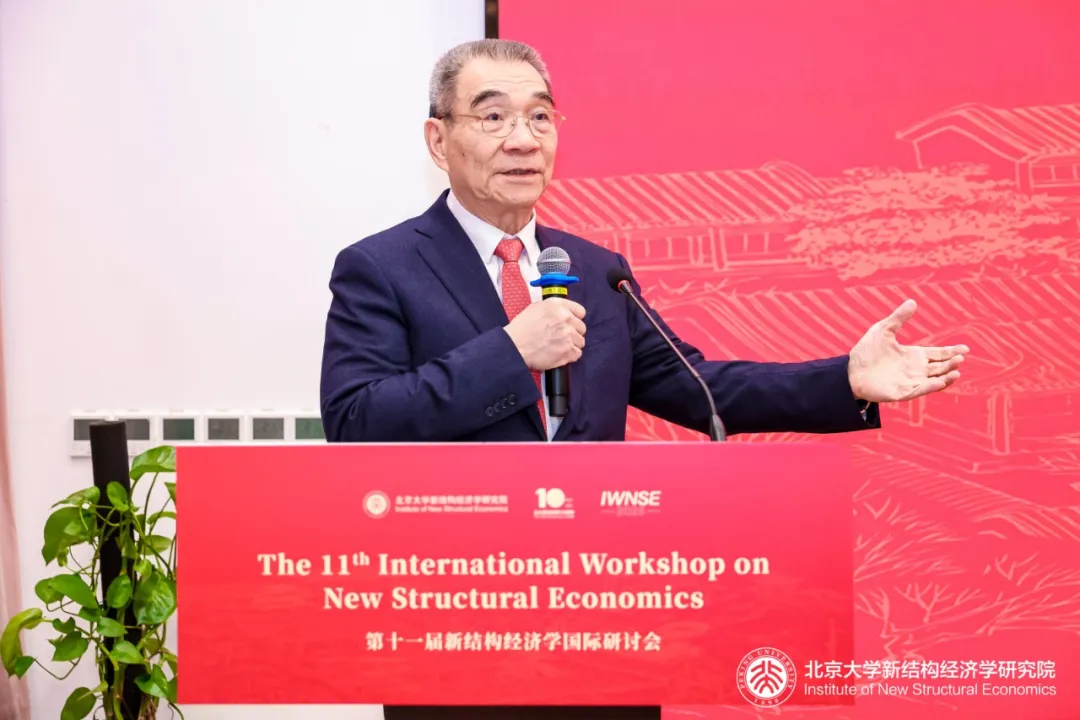
At the opening session, Professor Justin Yifu Lin, Dean of INSE at Peking University, delivered opening remarks, expressing gratitude to the participants for their support. He systematically introduced the framework and significance of New Structural Economics, reviewed the decade-long development journey of INSE, and shared prospects for the future of NSE. The opening session was chaired by Tenured Associate Professor Shenzhe Jiang, Deputy Dean of INSE at Peking University.
Morning Session
The morning session on December 12, Beijing time, was chaired by Tenured Associate Professor Shenzhe Jiang of INSE at Peking University.
Tenured Associate Professor Yong Wang, Deputy Dean of INSE at Peking University, presented a paper entitled "Leapfrogging by Switching Lanes: Directed Technical Change and China's Transition to Electric Vehicles." The study first empirically document the structured and phased policy approach in China's electric vehicles (EV) industry backed by nine major instruments. By constructing a dynamic industrial equilibrium model with two countries, two technologies (EV and GV), upstream and downstream innovation, and international trade, the paper theorize the mechanisms and quantify the short-term and long-term impacts of nine major types of policy tools with firm-level and product-level micro data. The research finds that China's initial technological gap in the EV field was smaller than that in traditional gasoline vehicles (GV), rationalizing the rapid switching. Although policies incurred significant fiscal costs in the short term, in the long run, China's EV industrial policies significantly improved domestic welfare and generated positive international spillover effects through increased consumer surplus and reduced global emissions. Policy sequencing and timing is critical to overall effectiveness of the industrial policy. Two members of INSE's Academic Advisory Council (hereinafter referred to as the "Council") gave comments: Michele Boldrin, the Joseph Gibson Hoyt Distinguished Professor in Arts & Sciences at Washington University in St. Louis, and Joseph Kaboski, the David F. and Erin M. Seng Foundation Professor at University of Notre Dame.
Tenured Associate Professor Shenzhe Jiang, Deputy Dean of INSE at Peking University presented a paper entitled "Optimal Monetary Policy in a Multi-sector Growth Model." By constructing a two-sector New Keynesian Endogenous Growth (NKEG) model incorporating an R&D-intensive sector and a traditional sector, and deriving a quadratic welfare approximation with cross-sector knowledge spillovers, the paper points out that in an innovation-driven economy, the high concentration of R&D activities in a few capital-intensive industries and their often asynchronous business cycles with the overall economy lead to time-varying cross-sector innovation externalities, thereby analyzing new trade-offs faced by optimal monetary policy. Vincenzo Quadrini, James McN. Stancill Chair in Business Administration at the University of Southern California, and Xi Weng, Professor in Economics at Peking University.
Tenured Associate Professor Xin Wang of INSE at Peking University presented a paper entitled "Enabling Comparative Advantage: Public Infrastructure and the Role of the State." Combining systematic cross-country evidence with a stylized trade model, the paper documents large and persistent gaps between endowment-implied specialization and observed exports in developing economies, and shows how public investment in transport infrastructure helps rationalize why only some countries are able to translate latent comparative advantage into actual export specialization. Two Council members gave comments: Ping Wang, Seigle Family Distinguished Professor at Washington University in St. Louis, and Celestin Monga, Adjunct Professor of Public Policy at Harvard's Kennedy School of Government, former Vice-President and Chief Economist of the African Development Bank Group.
Afternoon Session
The afternoon session on December 12, Beijing time, was chaired by Tenured Associate Professor Lijun Zhu of INSE at Peking University.
Tenured Associate Professor Mingzhi Xu of INSE at Peking University presented a paper entitled "FDI, Biased Technical Change, and the Elusive Labor Market Power." By constructing a theoretical model with a CES production function allowing for labor-augmenting technological progress, empirically estimating firm-level wage markups based on this model, and using a difference-in-differences approach to examine the impact of FDI liberalization on wage markdown, the paper finds that FDI liberalization primarily induced labor-augmenting technical change and intensified product market competition, which together led to a significant decline in firms' wage markdown, i.e., a weakening of labor monopsony power. The paper was commented on by Associate Professor Yao Amber Li of the Hong Kong University of Science and Technology, and the council member Senior Fellow Santiago Levy of The Brookings Institution, the former Vice-president of Inter American Development Bank.
Tenured Associate Professor Lijun Zhu of INSE at Peking University presented a paper entitled "Endowment, Industrial Upgrading, and Growth in an Open Economy: An Analysis of China." By constructing a multi-sector dynamic general equilibrium model, the paper analyzes the interactive mechanisms among factor endowments, industrial upgrading, and economic growth under open economy conditions, conducting research against the empirical background of China's industrialization process from 1978 to 2017. The research finds that in an open economy, there exists a bidirectional reinforcement mechanism between factor endowments and industrial upgrading. Trade and migration primarily promote capital accumulation and long-term growth by driving industrial upgrading. Factor endowments are a key force driving industrial upgrading, while industrial upgrading is a necessary condition for maintaining high capital returns and promoting sustained accumulation. This mechanism provides an important theoretical explanation and empirical support for China's industrialization and economic growth over the past four decades. The paper was commented on by Professor Jianpo Xue of the Xiamen University, and Siyu Chen, Assistant Professor of the Renmin University of China.
Assistant Professor Chunzan Wu of INSE at Peking University presented a paper entitled "A Win-Win Path to Economic Development and Energy Efficiency." By constructing a dynamic heterogeneous firm theoretical model incorporating increasing returns to scale in electricity usage and conducting empirical tests using Chinese firm-level data, the paper points out significant economies of scale in electricity usage: the larger the firm size, the lower the electricity consumption per unit of value added. The analysis indicates that lowering electricity prices and improving power supply reliability can incentivize firms to invest more and expand scale by increasing current profits and easing financing constraints; this scale expansion, in turn, enables firms to more fully utilize the economies of scale in electricity usage, thereby increasing output while reducing overall electricity intensity, achieving a "win-win" for economic growth and energy efficiency improvement. Two Council members gave comments: Keun Lee, Distinguished Professor of Seoul National University, and Finn Tarp, Professor of Development Economics of the University of Copenhagen.
Assistant Professor Wei You of INSE at Peking University presented a paper entitled "Industrial Policy and Latent Comparative Advantage: Evidence from Chinese Counties, 1998-2020." By constructing a comprehensive county-level industrial panel dataset (1998-2020) and employing an empirical model combining difference-in-differences and propensity score matching, the paper systematically evaluates the causal effects of county-level industrial policies in China and their alignment with different theoretical frameworks. Simultaneously, the paper establishes a two-region, two-industry spatial equilibrium theoretical model, introducing local government subsidy competition and cross-regional labor mobility to analyze the welfare implications of industrial policies under agglomeration effects. The analysis finds that the effectiveness of industrial policies highly depends on whether the policies align with the local latent comparative advantage. Decentralized local government subsidy competition can, under certain structural conditions, serve as an effective mechanism to correct historical misallocation and promote industrial spatial reconfiguration. The paper was commented on by the Council member Professor Ann Harrison, former Dean of the Haas School of Business, University of California, Berkeley, and Assistant Professor Haochen Zhang of the School of Economics, Zhejiang University.
At the end of the workshop, Dean Justin Yifu Lin expressed his sincere gratitude to all participants and spoke highly of the seven papers presented and the corresponding comments. He eagerly looks forward to working with colleagues in the future to jointly devote efforts to studying China's economic miracle, caring for the economic well-being of all humanity, and continuing to strive for in-depth research on economic development and structural transformation.
The Seventh Meeting of the Academic Advisory Council of the Institute of New Structural Economics (INSE) at Peking University
The Seventh International Academic Advisory Council Meeting of INSE at Peking University was successfully held on the evening of December 12, Beijing time. The meeting was chaired by Professor Yong Wang. Professor Wang first introduced the research agenda and achievements of INSE to the participants. Nine Council members then offered many pertinent suggestions regarding the research topics and the future development of INSE.
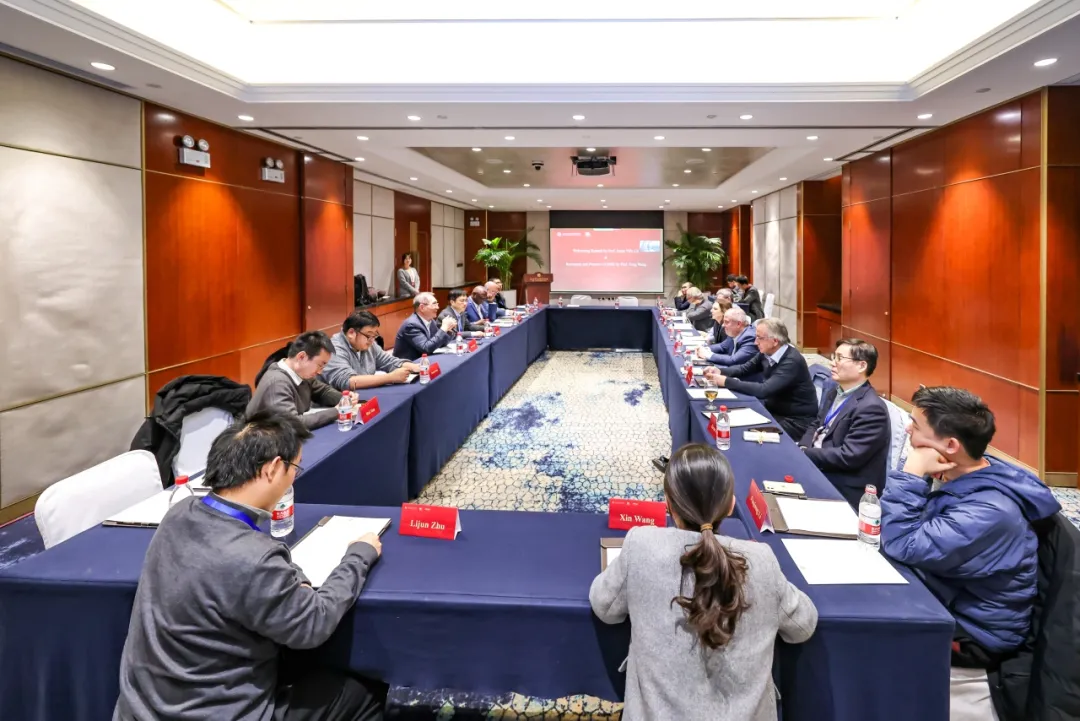
The International Academic Advisory Council of INSE at Peking University is composed of 21 internationally renowned economists. It convenes annually to provide advice for the development of INSE. Professor Alojzy Nowak, Rector of the University of Warsaw and other eight Council members attended this year's meeting.